Neither ESG nor GLP-1 medication is better for everyone: ESG suits eligible adults who prefer an endoscopic procedure, while GLP-1 medication suits eligible adults who prefer a nonsurgical prescription treatment. In 2026, the deciding factors are your medical history, treatment preferences, ability to continue follow-up, and willingness to accept procedural risks or ongoing medication side effects.
TL;DR
- ESG vs GLP-1 is a medical-fit decision, not a universal ranking of weight loss treatments.
- ESG reduces stomach volume through endoscopic suturing; GLP-1 medication acts on appetite and fullness pathways.
- Both approaches require nutrition support, follow-up, and a long-term weight management plan.
- Palm Med Wellness offers physician-led medical weight loss with medication and endobariatric options in Palm Beach Gardens.
Why this matters
A procedure and a prescription create different responsibilities. ESG involves preparation, anesthesia, recovery, and dietary progression; GLP-1 treatment involves medication administration, dose decisions, side-effect monitoring, and planning for continued treatment.
Palm Med Wellness offers physician-led medical weight loss and endobariatric procedures in Palm Beach Gardens. For your 2026 consultation, compare the entire treatment plan—not just the intervention that starts it.
ESG vs GLP-1 medication: which is better for weight loss?
Choose according to clinical suitability and the treatment burden you can sustain. Neither approach guarantees a particular amount of weight loss, and neither replaces ongoing medical care.
What it does
- ESG: Uses internal sutures to reduce stomach volume
- GLP-1 medication: Acts on pathways involved in appetite and fullness
How treatment starts
- ESG: Endoscopic procedure through the mouth, usually under general anesthesia
- GLP-1 medication: Prescription treatment with medication-specific instructions and dose adjustment
Best for
- ESG: Eligible adults who prefer a procedural approach and accept recovery requirements
- GLP-1 medication: Eligible adults who prefer a nonsurgical approach and can maintain medication follow-up
Main advantage
- ESG: Changes stomach anatomy without removing stomach tissue
- GLP-1 medication: Avoids an endoscopic procedure and allows prescription adjustments
Main limitation
- ESG: Requires anesthesia, recovery, and post-procedure dietary changes
- GLP-1 medication: Requires continued prescribing decisions and management of medication effects
Important risks
- ESG: Bleeding, infection, perforation, and anesthesia complications
- GLP-1 medication: Gastrointestinal side effects and drug-specific warnings or contraindications
Long-term responsibility
- ESG: Nutrition, activity, symptom monitoring, and follow-up
- GLP-1 medication: Nutrition, activity, symptom monitoring, and ongoing medication review
A person who dislikes injections is not automatically an ESG candidate. Likewise, a person who wants to avoid anesthesia is not automatically eligible for a GLP-1 prescription. Clinical screening comes before preference.
ESG: best for eligible adults who prefer a procedural approach
Endoscopic sleeve gastroplasty, or ESG, uses an endoscope passed through the mouth to place sutures inside the stomach. These sutures reshape the stomach and reduce its usable volume without removing stomach tissue.
ESG is different from a surgical sleeve gastrectomy. The names sound similar, but a surgical sleeve removes part of the stomach; ESG does not. Ask your clinician to identify the exact procedure being discussed before comparing benefits or recovery requirements.
What favors ESG?
ESG deserves consideration when you meet the procedural criteria and prefer an anatomy-based intervention over medication as your main treatment. It also requires a willingness to follow the prescribed dietary progression while your stomach heals.
The practical advantage is avoiding a medication-only strategy. The trade-off is accepting an endoscopic procedure, anesthesia, and recovery rather than simply stopping a prescription if you dislike the experience.
What counts against ESG?
A procedure adds risks that medication alone does not: bleeding, perforation, infection, and anesthesia-related complications. Your endoscopist must also assess whether your stomach anatomy and medical history make ESG appropriate.
ESG does not guarantee that weight regain will never occur. Eating patterns, medical conditions, and follow-up still matter, and further treatment can become part of the plan.
Discuss ESG when you want a procedural option—not because you expect a procedure to eliminate long-term care.
GLP-1 medication: best for eligible adults who prefer nonsurgical care
GLP-1 medications act on biological pathways involved in appetite, fullness, and blood sugar regulation. Some also slow stomach emptying, although the effect varies by medication and over the course of treatment.
A prescription-based approach avoids endoscopic suturing and anesthesia. Your clinician can review the dose, response, and tolerability as treatment progresses, rather than making a procedural decision at the outset.
What favors GLP-1 treatment?
Medication deserves consideration when you meet the prescribing criteria, prefer nonsurgical treatment, and can maintain regular clinical review. It offers a way to assess your response during treatment without changing stomach anatomy.
The advantage is flexibility in prescribing decisions. The limitation is that adjusting or stopping treatment also requires a plan; weight management does not end when a prescription changes.
What counts against GLP-1 treatment?
Nausea, vomiting, diarrhea, constipation, and abdominal discomfort are recognized side effects. Persistent symptoms can interfere with eating or drinking and require clinical review rather than simply waiting for the next appointment.
Contraindications and warnings differ by medication. Your clinician should review pregnancy plans, other medicines, gastrointestinal conditions, and the specific product's safety information before prescribing.
Choose a prescription plan you can follow safely, not a dose you feel pressured to reach.
Who qualifies for ESG or GLP-1 medication?
Eligibility begins with a medical assessment, not a preference questionnaire. Your clinician should review weight-related conditions, prior treatments, current medications, nutrition, and any history that changes procedural or prescribing risk.
For many FDA-approved chronic weight management medications, adult eligibility includes a body mass index of 30 kg/m² or higher, or 27 kg/m² or higher with a weight-related health condition. These thresholds do not establish eligibility for every medication, and meeting them does not mean a prescription is appropriate.
ESG has its own device, procedural, and clinical criteria. Do not assume that qualifying for medication means you qualify for ESG, or that a medication contraindication automatically makes ESG appropriate.
For a 2026 assessment, bring your current medication list and relevant medical records. Include previous weight loss treatments, your response to them, and the reason each treatment ended. That history helps distinguish a tolerability problem from an incomplete treatment trial or a change in health needs.
Why ESG and GLP-1 results vary
Weight loss is not determined by the treatment name alone. These factors affect how a plan works in practice:
- Clinical suitability: Your health conditions influence which treatments are appropriate and how closely you need monitoring.
- Treatment tolerance: Medication symptoms or procedural recovery can affect nutrition, hydration, and your ability to follow instructions.
- Treatment consistency: Prescription use, dietary progression, and scheduled reviews are different responsibilities, but each matters.
- Nutrition and activity: Both approaches need a plan that supports adequate nourishment, physical function, and sustainable eating habits.
- Follow-up decisions: A plateau, new symptom, or change in health should prompt reassessment rather than an automatic escalation.
These factors explain why another person's experience is not a forecast for yours. Ask your clinician how progress will be judged and what would trigger a change in the plan.
How should you compare the options at a consultation?
Use a structured discussion rather than asking only which treatment produces more weight loss. A useful consultation ends with a clear rationale, safety instructions, and a follow-up plan.
- Review history. Describe prior treatments, current symptoms, health conditions, and pregnancy plans. Explain what made earlier approaches difficult to continue.
- Check eligibility. Ask which option you qualify for and which findings would rule it out. Request an explanation specific to your health history.
- Compare burdens. Discuss anesthesia and recovery for ESG, and medication administration and side effects for GLP-1 treatment. Include your work schedule and caregiving responsibilities.
- Plan follow-up. Establish who manages symptoms, how treatment response is reviewed, and what happens if progress stalls.
The best recommendation explains both why an option fits and why the alternative is less suitable. If the discussion skips disadvantages, ask for them directly.
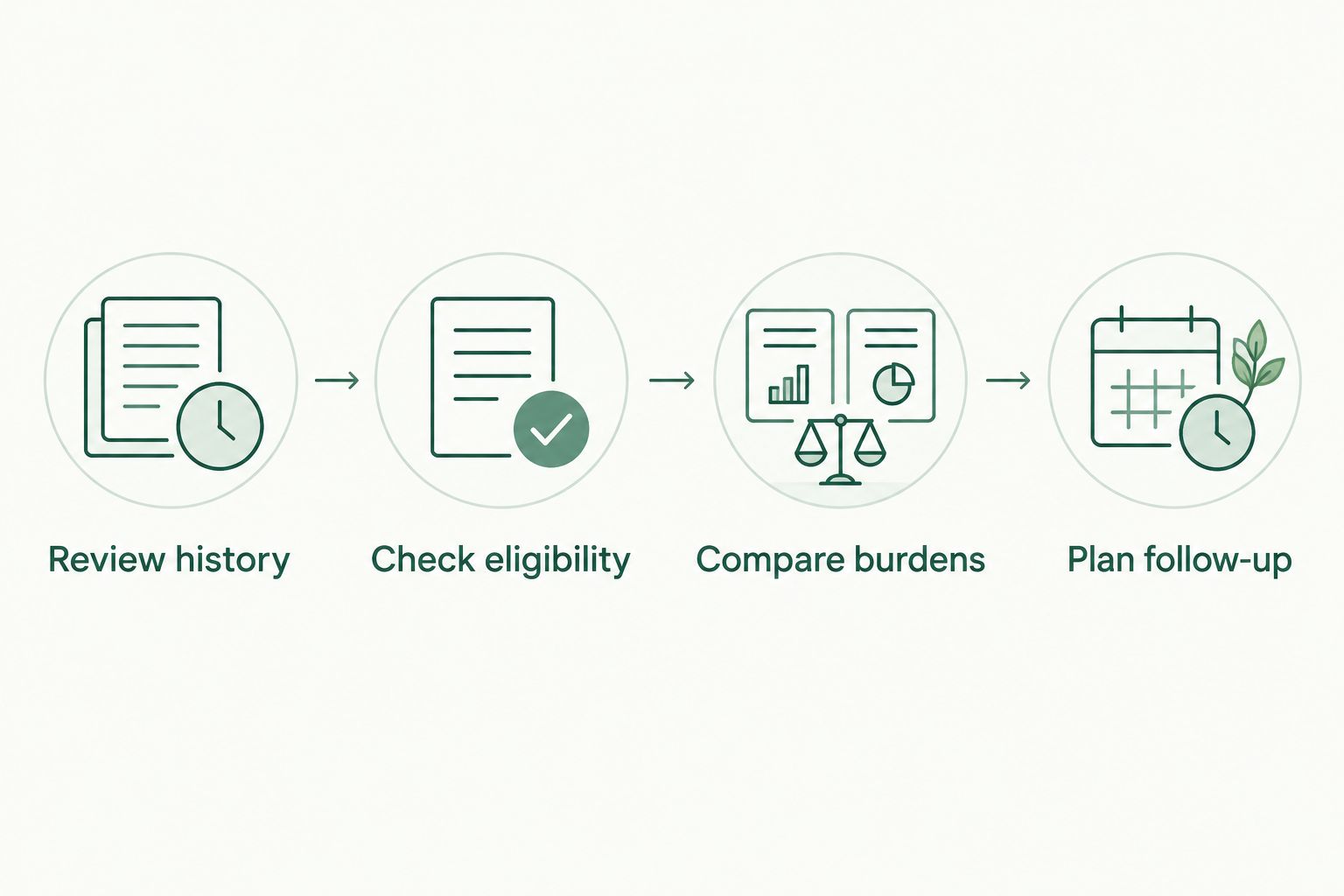
Medical suitability comes before treatment preference.
For help assessing procedural care, review the guide to ESG providers in Florida. Use the consultation to establish who performs the procedure and who manages your care afterward.
What should long-term follow-up include?
Your 2026 treatment plan should address more than body weight. Discuss food tolerance, hydration, bowel symptoms, physical function, and whether your current plan remains practical.
Adequate nutrition matters with both approaches. Reduced appetite or smaller meals do not automatically provide enough protein or other nutrients; ask for an eating plan that fits your medical needs rather than adopting a restrictive online menu.
The U.S. Department of Health and Human Services recommends at least 150 minutes per week of moderate-intensity aerobic activity for adults, along with muscle-strengthening activity. After ESG, follow your procedural team's activity restrictions; with either treatment, adapt activity to your health and current ability.
Agree on how to report symptoms between appointments. Severe or persistent abdominal pain, repeated vomiting, inability to keep fluids down, or signs of gastrointestinal bleeding require prompt medical evaluation, not a routine progress message.
Can you use GLP-1 medication after ESG?
GLP-1 medication can be considered after ESG when a treating clinician identifies an appropriate indication. A procedure does not automatically rule out medication, but combining treatments requires an individualized assessment.
The clinician needs to review your response to ESG, nutritional intake, symptoms, and medication eligibility. Do not add medication independently or assume that combining treatments guarantees a larger benefit.
What happens if you stop GLP-1 medication?
Weight regain can occur after GLP-1 medication is stopped. Appetite effects change when treatment ends, so stopping should include a discussion of nutrition, activity, monitoring, and alternative treatment when appropriate.
That does not mean every person has the same outcome. It means the stopping plan belongs in the original treatment discussion—not only in the appointment when you decide to discontinue.
FAQ
Is ESG better than GLP-1 medication for weight loss?
Neither ESG nor GLP-1 medication is universally better. ESG is a procedural option, while GLP-1 treatment is prescription-based; the right choice depends on eligibility, risks, preferences, and long-term follow-up.
Is ESG the same as gastric sleeve surgery?
No. ESG uses endoscopic sutures to reshape the stomach without removing stomach tissue, while sleeve gastrectomy surgically removes part of the stomach.
Can I choose ESG just because I do not want injections?
Avoiding injections is a preference, not an ESG eligibility criterion. A clinician must assess your medical history, stomach anatomy, and suitability for anesthesia and the procedure.
Do I still need nutrition support with ESG or GLP-1 medication?
Yes, both ESG and GLP-1 treatment require attention to nutrition. Smaller meals or reduced appetite can make it harder to meet nutritional needs without a suitable eating plan.
Can I take GLP-1 medication after having ESG?
GLP-1 medication can be considered after ESG when clinically appropriate. Your treating clinician should review your procedural response, symptoms, nutritional intake, and medication eligibility before prescribing.
What should I ask before starting either treatment?
Ask why the treatment fits your medical history, what its main risks are, and who manages follow-up. Also ask what happens if side effects develop, progress stalls, or you need to change treatment.
Where can I discuss ESG and GLP-1 options in Palm Beach Gardens?
Palm Med Wellness offers physician-led medical weight loss, GLP-1 medications, and endobariatric procedures in Palm Beach Gardens. A consultation can address which treatment options fit your medical history and preferences.
One last thing
The most useful question is not “Which treatment wins?” but “What happens if this plan needs to change?” A clear answer should cover symptom management, stalled progress, and the next clinical decision—not promise that you will never need another intervention.
For your 2026 decision, choose a plan with an explicit follow-up pathway. Call Palm Med Wellness or book a consultation to discuss ESG, GLP-1 medication, and the medical assessment that comes before either choice.
Discuss your weight loss options
Review medication and endobariatric options with a physician-led clinic in Palm Beach Gardens.